quinta-feira, 21 de julho de 2011

Não Há Becos Sem Saída

A todos quantos acham que o Becos são recantos obscuros sem saída, Sofia Pedroso anunciou há pouco ao mundo que Todos os Becos Têm Saída. As suas palavras foram escritas em livro, o seu primeiro, fruto da sua própria experiência.
Sofia não menciona investigações, não se escuda em exemplos alheios, não recorre a textos científicos. O que escreve vem de dentro, do mais fundo de si e é o produto da sua vivência. Factual. Cru. Brutal.

E ao longo das breves páginas do seu livro, Sofia desmonta o processo que nos pode conduzir a um Beco. Só esta palavra magoa. «Naquele momento em que me senti à beira do abismo, o que mais me perturbou foi a convulsão de pensamentos que me assolavam num ritmo quase frenético (...) Os pensamentos surgiam maioritariamente no silêncio da noite (...).»

E Sofia avança logo de seguida para nos mostrar a... saída que o Beco tem. O Beco afinal é fraco, não tem força nenhuma, vive da aparência que nos causa e só é bem-sucedido se lhe damos importância. «Tens objectivos? Eu não tinha até há bem pouco tempo, e estou convencida que a maioria das pessoas não tem. Mas todos temos sonhos. Queremos ser felizes, financeiramente independentes, morrer de velhice. Há quem aspire à ribalta, queira fazer histórias ou salvar a nação (...)». E logo, logo depois de explicar como se dá à luz objectivos deliciosos e alcançáveis, a autora alerta «O que interessa é que no fim tenhas como objectivo algo que desejes incondicionalmente.»

A escrita é escorreita e flui como um riacho por entre as margens, sem maneirismos nem rendilhados literários pomposos, não há «você», o «senhor», «tenha», «faça» ou «pense». O «tu» impera. Deferências para quê se afinal somos iguais e a vida passa por todos nós e deixa marcas, uns mais que outros? Ah, o grafismo, o grafismo faz apetecer ler. Sofia, escreve mais, por favor.

Os Becos, esses, entraram em declínio, com este livro. Não Há Becos Sem Saída é uma lição de vida e de crescimento pessoal. Não é discutível nem argumentável. É a mais pura verdade, vinda do núcleo.

Não Há Becos Sem Saída é inteiramente grátis e para fazer o download aceda ao site http://www.sentirpositivo.com/ ou clique directamente aqui.

segunda-feira, 11 de julho de 2011

As pedras da nossa vida (Our life's stones)


Here is a small story about life attitudes and how can we take control of our destinies. I've taken this story, a metaphor, from a great book of Richard Bandler, «Get The Life You Want».
Once upon a time there was a king who placed a boulder right in the middle of a street. Then he hid himself behind a bush to watch what would happen after. Some of the wealthiest merchants and courtiers came on but only bypassed or complaint about the boulder. Some even blamed the king for not order the withdrawal the boulder away.

All of a sudden, a peasant just showed up carrying a load of vegetables. When he faced the boulder, he landed the vegetables and started trying to remove the boulder from the way. He pushed one, two, three times, and, with all his effort, finally he managed to remove the boulder.

He was happy and prepared to go his own way again, but suddenly he saw a small purse in front of him, right in the same place where the big stone was. The purse had some gold coins and a paper with a message from the king saying the coins were to the one who managed to remove the boulder from the way.

And the story ends here. All of us can chose the way we deal with the stones of our life. We can remove them from our way or stand still, blaming or complaining.

domingo, 10 de julho de 2011

Os 5 C da mudança (The five C of change)


Concern, Confrontation, Clarification, Critalization, Change

Kets de Vries defined this 5 steps for a changing process, whatever organizational or personnel.

Concern - Happens just before the change process. It is a period of huge suffer, lack of comfort, with too much stress, anxiety and depressive episodes. In this first stadium there are feelings of, hate, anger, anguish, deep sadness, burnout.

Confrontation - When you confront yourself with the need of change, like «Something have to happen», «I must do something».

Clarification - This is the moment when you make a type of a commitment with yourself involving other too. When you tell others, family or friends, that you are going to change something.

Cristalization - The phase when you are on your own way, with new habits, new behaviors, new ideas. You are moving away from the peace of your old life.

Change - Finally, this is your future, you are already on your new way.

Thing of these five steps and understand where are you now. Then, is up to you

sábado, 9 de julho de 2011

Balzac e os funcionários. O Bajulador

Li algum Balzac depois de ter consumido cerca de quatro dezenas de obras de Camilo Castelo Branco. Estava nos meus 18 anos. Considero Camilo um criativo da linguagem, rico em adjectivos, descrições pormenorizadas, mordaz, irónico, sarcástico. Na minha modesta opinião, comparo Camilo a Balzac, se bem que este último teve vivência enriquecida no centro da Europa, em plena Paris, onde se inspirou nos tiques da alta sociedade.

Há uns meses fiquei perplexo quando nas bancas de uma livraria, o meu passeio preferido, encontro um Balzac diferente, «Os Funcionários» (título original: «Physiologie de L'employé»). Um livro editado pela Padrões Culturais Editora, que comete um crime literário ao publicar este livro como se tivessem atirado vírgulas como se de milho para as galinhas se tratasse. Onde caíram assim ficaram. Uma pena, ainda mais com tão pomposo nome de... Padrões Culturais. Enfim.

Honoré de Balzac descreve com mestria as características dos funcionários públicos da época, séc.XIX. E é arrepiante a parecença do retrato. Transcrevo aqui a do Bajulador, dedicado a todos os bajuladores funcionários, públicos ou privados.

«O Bajulador

Sempre medíocre, este funcionário sobrevive à custa dos serviços que presta e do terror que espalha. Linguareiro com os chefes de departamento e de divisão, estuda-os e conquista a sua confiança. Acaba por lhes conhecer os gostos e os seus caprichos. Presta-lhes todo o tipo de serviços e conta-lhes tudo o que se passa nos gabinetes.
E se ainda assim continua, apesar do desprezo que inspira, é apenas porque é indispensável e conhece demasiados segredos. E se a esta enorme fraude associarmos um pouquinho de talento ou de ambição, acaba facilmente por ser promovido. Costuma ser dedicado e nem se importa de ser desprezado ou ignorado, suportando as consequências dos seus atrevimentos com tal calma que ninguém compreende, nem de onde lhe vem o poder, nem a resignação. Acham-no desprezível mas estende-lhe a mão. Alcunham-no de jesuíta. Denuncia um pouco, espia muito, conta tudo: na verdade, não lhe escapa nada!»

Ora aí está uma característica da natureza humana que não se altera no tempo ou na circunstância. Todos nós a temos um pouco, o problema é o parâmetro, o nível em que se manifesta.

quinta-feira, 7 de julho de 2011

Be aware if you are so comfortable


Tribes. What is a tribe? A tribe is a huge amount of people that follow something with meaning, an individual or a cause.
Seth Godin is one of my favorite writers. I’ve read recently «Tribes» and Seth Godin gives us a real lesson about leadership and change. Tribes wait for leaders and leaders must foster change to have tribes.
Change is difficult because we have to overcome status quo and beaurocracy. One of the strongest idea is titled as graze. And Seth says most of people are trained, are educated to be obedient, to accept idiot work with enough dose of fear. Fear of being fired. This is the same as saying we are prepared to be sheep in a herd.

What leaders do is to change this kind of herd behavior. They challenge the status quo. Seth Godin gives us an excellent example. Imagine a balloons factory. Everybody in this factory are fearful, people are afraid of edges, of temperature, pins and needles, even hedgehogs.
Everything all right, employees are comfortable, in a stable system, until it appears the unicorn. At first people say to unicorn to go way, to stand still, etc. But if the unicorn doesn’t obeys what happen? People run to the shelters. As you see, it is very easy to the unicorn to destabilize.

After all, what means this small story? The balloons factory is the status quo, the unicorn is the leader that change everything. So, be careful if you are so comfortable, what ever in your private life or in your workplace.

quarta-feira, 6 de julho de 2011

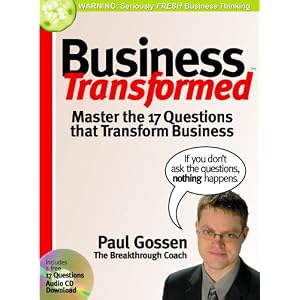
17 questions that can change a business or life


Paul Gossen has written a book, Business Transformed, with the essential 17 questions that can lead you to achive your dreams, your goals and can transform organizations. The book is very easy to read, a kind of intuitive with a great graphic design.

This book talks is all about coaching and explains what type of questions a coach have to ask in order to achieve a changing process. The importance of questioning order is stressed as well as silence must be held after each question. It is possible to download a media player file and listen all the 17 questions, just go http://www.businesstransformed.com/. Paul Gossen is a trainner, executive coach of Ericksson, and an entrepreneur.

So, an excellent book for all those linked to coaching

segunda-feira, 4 de julho de 2011

Forget what you were told about Motivation

The new era it is not about to start. It has already started. Theories about motivation are falling down. Why? Because just few things work and grow with rewards, carrots and sticks. We are not donkeys, after all.
The left side of the brain is leading at moment. It's not possible to evolve reproducing past patterns anymore. We need to produce innovation, creativity, solutions, alternatives, new ways of dealing. In recent past, we had basicaly beaurocracy, tasks, procedures, schedules, timetables, fear, threats. Now we more and more deal with passion, ideas, autonomy, purpose, significance or meaning. And rewards, carrots and sticks don't work... really. They are now nothing but an illusion.
Dan Pink explains this very well in his book, «Drive». Motivation 1.0; Motivation 2.0 and Motivation 3.0. What means these?
Motivation 1.0 it's about survival. For example, in our very early days, our behavior was lead by the need of survival, running from predators, etc.
Motivation 2.0 arouse when the complexity of societies grew. And then we start to operating like avoiding punishments and to seek rewards. It is linked to external desires and reality.
Motivation 3.0 drives now our behaviors. We need an intrinsic satisfaction, significance, purpose, mastery and engagement. Humans, by nature, seek purpose.

If you want to motivate your team give it a purpose, a meaning. Engage people with autonomy, allow people to reach mastery. Need something more? Please read the book. «Drive». You will not regret I assure.