The story of Mr. Séguin's Little Goat, of Alphonse Daudet, alerts us to a dual reality. Right or wrong, depends on the choice we make. Would it be a bad choice if we chose the path of constraints but at the same time safety and stable? Or would it be a bad choice if we, instead, chose the path of freedom but at the same time of insecurity, adventure and diversity? Mr. Séguin's little goat made a choice.
The little goat lived in complete safety, well fed, protected from the hardships of their own existence. Admittedly, had no room to run, had no access to the diversity of life, but she had everything she needed to live peacefully. Further has an owner who treated her well, which daily removed the milk and liked her very much. She was a lovely little goat, docile, affectionate, leaving milk without stirring, without putting their feet in the bucket.
Everything went well until one day she began to look at the mountain and realized that the world and life did not end there. So began thinking about how should be well up there, jumping between the vegetation without the damn rope around her neck!...
From that moment she seemed insipid. Befallen her boredom. Lost weight. The milk has declined. It was painful to see her dragging the rope all day, but looking the mountain. Mr. Séguin, the owner, was very upset, even worse when the little goat said to him: «Mr. Séguin, I'm not happy in this house, let me go to the mountain.»
The man stunned, became enraged. He offered to the little goat more pasture extending the rope and tried to find what she needed, but the little goat tried again: «I want to go to the mountain, Mr. Séguin.» Then the owner used a second strategy. The fear: «But, my little goat, don't you know there's a wolf in the mountain? What will you do when he comes? He already ate a lot of goats, greater than you...» But again the little goat insisted: «It doesn't matter, Mr. Séguin, let me go to the mountain.» Then came a position of strength: «Well, no ... I'll save you, to your regret! And because I am afraid that the rope breaks, I'll close the barn, and you'll be there forever.» The problem is that he forgot to close a window (after all, there is always a window...). And the little goat escaped...
Oh, how happy little goat became! No rope, no yoke, nothing in the way and lots of tasty grass, thousands of plants too... It was all very different from Mr. Séguin's house. With a forest full of wild flowers, the little goat rolled along the slopes. Even a young fawn had the luck to please to the little goat. The couple got lost in the woods for an hour or two. What a day, what a dream for the little goat. Suddenly the wind cooled. The mountain became violet. It was the night... And with it the wolf, UUUUU! Uuuuu!
Down there, the horn of Mr. Séguin screamed one last call for the little goat back... But she didn't want to come back, remembering the yoke, the rope and the fence. She thought it was better to stay. The horn did not sound more...
Sudenly, The little goat heard behind her a rumor of leaves. She turned and saw the shadow of two short ears with two eyes that glittered... It was the wolf. (...) Then the monster moved, and her little horns began to dance against the wolf. So brave little goat was. One after another, she redoubled the investees, and the wolf bites...
Until the goat, so exhausted from the struggle to resist itself was spread over the whole land spotted with blood... Then the wolf threw himself on the little goat and devoured her.
A história da Cabra do Sr. Séguin, de Alphonse Daudet, alerta-nos para uma realidade dual. Certa ou errada, qualquer uma delas depende da nossa escolha. Será mau escolher a via das restrições, dos condicionamentos e das limitações mas ao mesmo tempo da segurança, do recato, da rotina e da estabilidade? Ou será mau escolher a via da liberdade, das alternativas e das hipóteses mas ao mesmo tempo da insegurança, da aventura e da diversidade? A cabra do sr. Séguin escolheu um caminho, tal qual as suas antecessoras. Aceitam-se opiniões.
A cabra vivia em completa segurança, bem alimentada, protegida das agruras da própria existência. É certo que não tinha espaço para correr, não tinha acesso à diversidade da vida, mas ela tinha tudo o que necessitava para viver tranquilamente. Ainda por cima um dono que a tratava bem, que lhe tirava o leite e que gostava muito dela. «Era um amor de cabrinha, dócil, carinhosa, deixando-se ordenhar sem se agitar, sem meter os pés no balde.» Até que um dia se pôs a olhar a montanha e percebeu que o mundo e a vida não acabava ali. Havia muito mais a descobrir. E pôs-se a pensar como se devia estar bem lá em cima! saltar entre a vegetação, sem a maldita corda que esfolava o pescoço!... «A partir desse momento a erva do cercado pareceu-lhe insípida. Sobreveio-lhe o tédio. Emagreceu. O leite diminuiu. Dava dó vê-la arrastar a corda o dia inteiro, a cabeça voltada para o lado da montanha, a venta aberta, fazendo “mé”... tristemente.» E disse ao dono aquando da ordenha: «Sr. Séguin, eu enlangueço em sua casa, deixe-me ir à montanha.» O homem entonteceu, enfureceu-se, admirou-se com aquela pretensão. Ofereceu à cabrinha um pouco mais de pasto alargando-lhe a corda, procurou saber o que lhe faltava, mas a cabrinha: «Quero ir para a montanha, Sr. Séguin.»
E o seu dono passou a uma segunda estratégia. A do medo. «Mas, desgraçada, tu não sabes que há o lobo na montanha? Que farás quando ele vier? O lobo pouco se importa com os teus chifres. Ele comeu cabritas muito mais chifrudas do que tu... E a cabra insistia: «Isso não importa, Sr. Séguin, deixe-me ir à montanha.»
Como o aliciamento e o medo não resultaram, então veio a posição de força: «Pois bem, não... Eu te salvarei, a teu pesar, velhaca! E, porque receio que rompas a corda, vou fechar-te no estábulo, e ali ficarás sempre.» O problema é que se esqueceu de uma janela aberta (porque afinal há sempre uma janela...). E a cabrinha lá foi...
Como a cabra ficou feliz! Nada de corda, nada de canga... nada que a impedisse de pular, de pastar à sua maneira... E quanta erva havia lá! Até lhe ultrapassava os chifres, e que erva! Saborosa, fina, recortada, feita de mil plantas... Era muito diferente do capim do cercado. E as flores, toda uma floresta de flores selvagens, a cabra espojava-se com as pernas para o ar e rolava ao longo das encostas.
«Até um jovem gamo de pelagem negra teve a sorte de agradar a Branquinha. Os dois namorados se perderam entre o bosque, durante uma ou duas horas. De repente o vento esfriou. A montanha tornou-se violeta. Era a noite... E com ela o lobo, Uuuuu! Uuuuu!
Lá em baixo, a trompa do Sr. Séguin gritava num último apelo para que a cabrinha voltasse... Branquinha teve vontade de voltar, mas lembrando-se da canga, da corda, da cerca do curral, pensou que já agora não mais se podia afazer àquela vida, e que era melhor ficar. A trompa não soou mais... A cabra ouviu atrás de si um rumor de folhas. Voltou-se, e viu na sombra duas orelhas curtas, muito direitas, com dois olhos que reluziam... Era o lobo. (...) Então o monstro avançou, e os pequenos chifres começaram a dança. Ah! a valente cabrinha, como lutava com todas as forças! Uma após outra, Branquinha redobrou as chifradas, o lobo as dentadas... Até que a cabrinha, exausta de tanta luta para resistir, ela própria se estendeu por terra toda malhada de sangue... Aí o lobo atirou-se sobre a cabrinha e a devorou.
The mobile phone retail company Ensitel is facing a problem because of bad costumer service. Some years ago, one of the company stores based in Lisbon sold a mobile phone Nokia to a customer, a lady. Nevertheless, after a week, the phone display lost its light. At that moment the customer, who tells the hole story in her blog, http://www.jonasnuts.com/, started a real nightmare. The company refused to change the phone or solve the problem, and after several months of correspondence exchange, the case went to court, that, unfortunately, as usual in Portugal, was postponing the decision. Note that, by law, the issue was clear: Ensitel had only to deliver new equipment to the client or return his money. Nothing happened however and until recently... (...)
Today, December 29, I've read in a daily newspaper and in a weekly one that Ensitel appealed to the court in order to compel the customer and blogger to withdraw from her blog all the posts that told the hole story. The story of a nasty customer service provided by Ensitel.
What happened then? Instead of protecting itself from the real truth, we can now realize the great role of social media. Ensitel is tarnished in Facebook and Twitter. The costumer voice can't be banned from the net. Shame on Ensitel and its service. And, by the way, what is happening to Justice system in my country?
There are many people who take long time saying «I», «my» and «me». They spend most of the time praising themselves, selfishly focusing on their own. Usually they get scared if someone around is shining. It is mainly these type of people that make workplaces poorer, overshadowing all with their self-praise, to much talking, interrupting and shouting (even worse when they are incompetent). Nevertheless, this kind of people live in permanent pain. To feel well, they need to have power, so they fight for it all the time.
A more open attitude would make them happier and healthier. It's all in the books, is available to anyone. On this theme, Dalai Lama, in one of his speeches, says this words: «In America, a scientist who was attending a conference presented a study which showed that people who often use the words "I", "My" and "Me", being self-centered people, who see themselves as very important, are at greater risk for heart attacks. The reason for this seems quite simple. People with self-centered mindset have a very narrow and limited attitude. Thus, a small problem that arises seems to them to be a big problem. On the other hand, if the mind is wide open, even facing a serious problem, this will not seem so important. The vast and open attitude makes all the difference. The attitude of compassion means feeling of caring for others. And that emotion and attitude automatically widen our perspective towards life, while the selfish motivation closes our mental attitude. (...)»
Knowing that we can't change an individual with such characteristics, at least let's do better by ourselves. Let's be more open. First step, understand that such an individual has problems, maybe since childhood. Second step, we knowing that we can't change the individual concerned, we have two chances: either live with and manage the situation, or we leave it.
In my opinion, the best way is the second one, because, as Jim Rohn said, «Never underestimate the power of influence.» What means if we cohabit with a negative person every day and for long, soon we become like him, or similar. Do not scorn this statement.
São muitas as pessoas do «eu», do «meu» e do «mim» em contexto de trabalho. Acham-se o máximo e passam o tempo a elogiar-se, centrando-se egoisticamente em si próprias. Geralmente ficam apavoradas se alguém à sua volta se releva. São principalmente estas pessoas que tornam os locais de trabalho mais pobres, ofuscando todos com os seus auto-elogios, falando, interrompendo, gritando ou berrando. Mais grave ainda é quando a sua competência deixa a desejar. São pessoas que sofrem, o poder é-lhes necessário e lutam por ele a todo o momento.
Uma atitude mais aberta torná-los-ia mais felizes e saudáveis. Está tudo nos livros, já foi estudado, está ao alcance de quem quer que seja. Sobre este tema, o Dalai Lama, numa das suas palestras, disse assim: «Na América, um cientista que participava numa conferência apresentou um estudo onde demonstrava que as pessoas que usam frequentemente as palavras "eu", "meu" e "mim", sendo pessoas centradas em si mesmas, que se vêem a si própiras como sendo muito importantes, correm um risco maior de sofrer ataques cardíacos. A razão para isto parece-me bastante simples. As pessoas centradas em si próprioas têm uma atitude mental muito estreita e limitada. Assim, um pequeno problema que surja parece-lhes ser um grande problema. Mas se a mente for ampla e aberta, então, mesmo perante um problema sério, este não parecerá tão importante. A atitude vasta e aberta faz toda a diferença. A atitude da compaixão significa o sentimento de cuidado pelos outros. E essa emoção e atitude alargam automaticamente a nossa perspectiva perante a vida, enquanto a motivação egoísta extrema fecha e estreita a nossa atitude mental. (...)»
Na impossibilidade de podermos mudar o outro, quando confrontados com um indivíduo com estas características, pelo menos façamos por nos melhorar. Sejamos mais abertos. Primeiro passo, compreender que um indivíduo como este tem problemas, se calhar desde a sua infância. Segundo passo, sabermos que, não conseguindo mudar o indivíduo em questão, das duas uma: ou vivemos com a situação e a gerimos, ou saímos.
Na minha opinião, a melhor hipótese será a segunda, pois, tal como Jim Rohn diz: «Nunca subestime o poder da influência». É que se convivermos com um indivíduo destes todos os dias e por muito tempo, cedo nos tornamos como ele, ou parecidos. Não desdenhe esta afirmação.
Probably you've already seen this video, but there are so many strong energies we can get from it that I couldn't resist to post it. A new year is coming and, as we usually think in a new life, new goals, start something, nothing better than watch this video to capture all the messagens it contains. Life lessons from mother nature. Enjoy
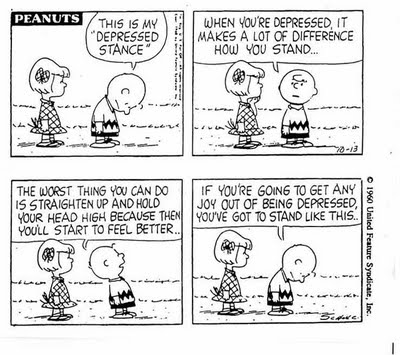
It is one of the principles of Neurolinguistic Programming (NLP). The stance one takes is determinant in how we feel. I reviewed a few weeks ago the DVD movie Against All Odds. In one scene, James Woods (Jake) tells Jeff Bridges (Terry) something like this: «You look frustrated !...», and Bridges answers: «I'm frustrated because I feel frustrated.» Bridges feeling had invaded his body stance. I don't know if he really wanted to look like that or just did not want to fight this feeling letting it control his body. As the above figure, Peanuts, if he wants to feel depressed, the worst thing he can do is stand erect and raise his head, because he'll improve. Keep on whether he is depressed to lower their shoulders and stare at the floor.
So when you feel bad, frustrated, disappointed, etc.., first to do is deliberately change posture. Raise your head, do not drop your shoulders, walk right and don't look at the floor. You'll see that you feel better.
However you'll feel weird, because the state of mind seems incompatible with an attitude, it all depends on what you want anyway. Continue to feel well... or better.